Tag: technology

  • The Spectrum of Authorship

    Authorship and Collaboration with AI

    I’ve been thinking a lot lately about authorship when it comes to making creative work through collaboration with AI. I’ve been particularly interested in how authorship changes once we start relying more heavily on technology to make our work.

    There’s a spectrum, I think, that runs from one extreme to the other. On one end is the composer who creates something entirely from themselves; literally just their body and their voice, no technology involved. They might sing, clap, and stomp in a purely improvised performance, creating an original work that is entirely ‘human’. As we move along the spectrum, we start introducing tools and technologies that extend what the body can do.

    At these early ends of the spectrum, that might be the human–machine collaborations of a violin or a cello. The performer still feels like the author of the work, but their authorship is now distributed across their body and the instrument. The music is only possible through their interaction with that tool.

    Then we move into the world of recording. Technologies like microphones, tape machines, and DAWs allow us not only to capture sound but to shape and reorganise it. Here, authorship starts to spread out a little further. You might record fragments from synthesisers, field recordings, speech, or existing works, rearrange them, sculpt them, and construct a piece that exists mostly through the editing and transformation of material. The composition becomes a kind of organisation of material — structuring sound to give it some aesthetic meaning. In these contexts, the composer’s work entirely relies on the capabilities of modern technologies.

    Tools, Systems, and Co-Creation

    Things become more interesting when we get to technologies that don’t just record or process sound but actually start generating or influencing the musical material. MIDI effects in a DAW are a perfect example of this. They operate not on the level of concrete audio (as synthesisers and audio effects do), but on the level of abstract musical content — notes, rhythms, and chords. It’s possible to send a single note into a rack of MIDI effects, automate a range of parameters, and end up with a sophisticated chord sequence using inversions, borrowed chords, and extensions. The composer here is engaging in complex approaches to technology. But who is making the chords?

    Or consider an arpeggiator, which transforms a single chord into a patterned melody. It’s not just amplifying the human input; it’s creating new abstract musical content (the notes rather than the sound of those notes).

    The technology suggests material, and the composer reacts to it in a form of collaboration — approving it (keeping it in the work) or rejecting it (trying another set of parameters). The composer can unexpectedly stumble upon highly sophisticated ideas through these sorts of processes. They’re relying on the technology to produce their complexity. Is this any different from a composer sitting at a piano, and importantly, relying on the piano to find their complex harmonic sequences?

    These sorts of systems blur the line between tool and collaborator. We’re still inclined to say that the resulting piece belongs to, and is authored by, the composer, even though the technology is now contributing directly to the creation of the material itself.

    Further along the spectrum, we get to a stage where we start working with technologies that behave more like agents — systems that can generate musical ideas on their own, improvise, or respond to us in real time. These could be algorithmic improvisers, generative systems, or AI collaborators.

    At this point, the question of authorship starts to unravel further. Who is the author here? Is it the composer, who initiated and guided the process? Is it shared with the coder or designer who built the system? What about the AI itself, which is now capable of producing new abstract and concrete material? We could say that it’s still the composer’s work — another case of using technology to extend creative capacity — but it does feel slightly different. There’s an agency to the process that pushes back, that seems to create with the composer-performer rather than for them.

    Sampling, Assembly, and the Role of the Composer

    Running parallel to these sorts of approaches is the culture of sampling. You can make a track entirely out of material from Splice — a drum loop from one person, a chord progression from another, and a melody from someone else. In these scenarios, almost every building block of the music comes from other creators — not to mention the technologies that went into creating and shaping those materials. Yet the sense of authorship still rests with the one who assembles it.

    This kind of authorship is about reorganisation: curating, reframing, and recomposing pre-existing materials. It’s not unlike crate-digging or collage. Sure, the composer is not inventing the raw materials, but they’re reorganising them into new configurations, giving them new contexts and meanings, often drastically different from their origins. Authorship here becomes less about creating from nothing and more about the composer’s methods of moving things around — how they impose structure, taste, and intention.

    In these settings, the composer engages with technologies or the processing of sourced material to create the core ideas and sounds. But their authorship comes from the assembly of these into musical structures.

    Harvesting Authorship in the Ecosystem of Creativity

    At the furthest end of the spectrum is the artist who types a prompt into an AI model, waits a few seconds, and receives a fully formed track — a finished .wav file that they can release immediately. Here, the idea of authorship becomes extremely fragile. Who made it?

    It doesn’t quite make sense to call the human the ‘composer’ of the work. The creative labour has been abstracted away; the AI is the one producing the abstract and concrete musical materials and organising them into a musical structure. The human is left as the initiator, prompter, or commissioner.

    But even here, it’s not completely clear-cut. If the AI outputs something editable — an entire DAW project, a SuperCollider patch, or even a .wav file that is then split into stems — the human can intervene, reshape it, and make it their own, potentially clawing back some authorship. In other words, the artist begins to harvest authorship back from the system. They inject themselves into the material, react to it, transform it, and in doing so, reclaim a sense of ownership. The process becomes a dialogue: a push and pull between automation and intention.

    How is this process different from getting a sketch or full piece sent over from a collaborator, which the composer then pulls apart, edits, remixes, and makes ‘their own’? (I’m referring here to the differences concerning authorship, not the morals of replacing human collaboration of this kind with AI-human collaboration.)

    Harvesting authorship describes the act of taking something that wasn’t entirely yours to begin with and imprinting yourself upon it through labour, curation, and interpretation. The more you interact, the more you reclaim.

    Across this whole spectrum, from singing with your body to collaborating with generative systems, the underlying question doesn’t really change. Modern techniques of music-making have pushed us further away from that human-only end of the spectrum. But composition is still about how much of yourself you put into the process, and how much the system gives back. What shifts is where the creativity sits, and what forms it takes — in the body, in the workflow, in the code, or in the back-and-forth between the composer and their technology.

    It’s also not just technology that we interact with in the creative process. Consider the interplay between the composer and the spaces they compose with in mind, or the audience members themselves. What about the composer drawing inspiration from biophonic and geophonic sources — birdsong, thunder, waves? Music-making is thus never a single-creator scenario. There is no single, individual author. Authorship, in the sense of ‘who made this?’, is a question of a vast ecosystem of culture, environment, and technology.

    Maybe authorship isn’t about who made what from scratch, but about how creative intentions move through systems. It’s less about purity or originality, and more about interaction, orientation, and the ways we steer complexity into coherence — how an author of a creative work takes a set of inputs as material and shapes them into something aesthetically valuable.

    In that sense, using AI in the creative process isn’t the ‘end of authorship’. It’s a change, for sure, but it’s really just another point on a spectrum that composition has always existed on.
  • Thoughts on ‘Pandora’s Star’ – Peter F. Hamilton

    Pandora’s Star is a science fiction book by Peter F. Hamilton, published in 2004. I began this one because I absolutely loved his recent book, Exodus: Archimedes Engine, which is set in the world of an upcoming video game. I gave that one an easy 5 stars – it had such interesting concepts, setting and a good pace.

    I felt that Pandora’s Star (PS) was good, but not as good as Exodus. PS felt bigger and wider than Exodus, but I felt that the writing at times was just a little unrefined. This is the most male gaze story I’ve read in a long time (potentially ever), where every female character was overly sexualised, young and most of the times using the attractiveness for manipulative purposes. While this was most likely just Hamilton’s style of writing back then, it could also have been interpreted as the state of humanity in a world where death has basically been overcome through ‘rejuvenation’ of the body, making everyone horny, sexy 18–25 year olds. At least that’s one way you could justify it… But all the interactions between a male and female character ultimately revolved around sex and attraction, which got a little old, but (even though I’m ranting about it here) didn’t really ruin the reading experience for me. Most of the time it just led to an eye-roll and laughter.

    The concepts were pretty bloody cool though. I’m relatively new to sci-fi; I’d say I’ve read 10 sci-fi books over the years, loving some like Hyperion and Children of Time, but also not loving a few. But I could tell while reading PS that the main antagonist, MorningLightMountain, was a very special kind of alien. I loved the chapters from its perspectives, while also being terrified of it. I think the thing that made it so special to me was its non-humanness; not really angry and wanting to just go out and wipe out the human race, but doing so from a place of not having the concepts of compassion or pain. It simply needs to expand, to take the resources, to become omnipresent and immortal – whatever is required to do so. What I loved was how this was scary when contrasted to how humans think – to human nature.

    I loved how an important conversation takes place with MorningLightMountain that aims to understand its goals, but it’s not carried out by a human; it’s between the alien and an AI. I thought this was interesting, seeing two different non-human consciousnesses discussing the fate of humanity, and seeing the AI as more human than the alien.

    Something I really enjoyed about the book was its look at not only new technologies, but their effects on humanity. Specifically, the book centres around the presence of wormhole technologies. There are places that in real space are separated by huge distances, but due to wormholes, they’re effectively neighbours (linked by a vast network of trains!) This is something I’ve been interested in quite a bit recently – how certain technologies drastically shape humanity, and what human life looks like in societies where those technologies dominate.

    I did have a hard time with the lack of a clear lead character. There are a lot of characters in this book, and it didn’t feel like one was the main one the reader should be rooting for. For me, I did find myself gravitating towards the Paula Myo character, and also the storyline of Ozzy Isaacs. But it was definitely more of a large ensemble of players, rather than a clear through-line character.

    Overall, really enjoyed it. It was a little wordy – it probably could have been cut down to 800-900 pages – but it was also really immersive. Keen for the second one, but won’t jump in straight away.

    4/5

  • Linking Knowledge and Technology

    Technology is the product of knowledge.

    The root of the word and concept of technology is the ancient Greek téchnē, which refers to art, craft, or skill. For Plato, téchnē meant something more than a mere knack or habit. It involved a deep understanding of a domain, and the ability to carry out a rational method for some creative purpose. This ‘rational method’ requires the craftsperson to know why what they do works the way it does; why that way is the best way to do something. In modern times, our concept of this is ‘technique’.

    Our concept of technology builds upon this: it is the knowledge and artefacts that allow for techniques to be carried out through mechanisation and automation, and allows these processes to be scaled. A piece of technology is the product of the process of applying deep knowledge and rational methods to produce something that fulfils some purpose.

    Consider the process of developing new technologies, whether they’re machines, devices or algorithms. It begins by gathering a pool of knowledge in usually several domains of knowledge. This involves understanding the principles of a field, as well as key problems or questions related to it. Skilled people are hired by a technology manufacturer, and/or they spend a large amount of time in the research phase, building the body of knowledge further. At a certain point, the focus is very much set on problems, and specifically on figuring out the best way of solving them. This may be a particular movement of an object, or a way of processing information. For example, product developers may come to the best methods for moving dirty clothes through water to clean them. This stage is aimed at building the essential techniques that can be used to solve the problems. This stage is an interesting one, because many of these techniques can be carried out by humans: they may be physical, physiological, or mental techniques. However, when building new technologies, once the techniques are decided upon, they are then mechanised, automated, and scaled. Those best techniques­—the ‘rational method’—for moving dirty clothes through water to clean them are programmed into a device that, when a button is pressed, goes through these motions. A customer of a new washing machine—and any technology for that matter—is buying an object that is capable of specific techniques: The techniques are the things that give the object value.

    Technology, knowledge and language are also linked in how they are all generative things, meaning that they evolve by combining simple building blocks of themselves into more complex structures, which are then further built upon. Words are built through combinations of other words, new technologies are built by combining existing technologies in new ways, and ideas are built by combining existing ideas. Our ideas in Western civilisation are based on a lineage of ideas tracing back to the ancient Greeks and beyond, into deeper history. In the same ways, our modern technologies are able to be traced back through a lineage.

    Knowledge and technology are thus absolutely intertwined and inseparable. Theory provides the basis for action, and technology materialises theory into artefacts. These artefacts are not only commodities but also products of a creative process. The creative process is the medium which the craftsperson moves through to turn their knowledge, understandings and rationality, into physical forms of technology.

  • I want my things to be scratched up with character

    I’ve got this weird thing that I’m being drawn to currently: the desire for character being reflected in the things I own and use regularly. I have a lot of things that look new — in top condition. And it’s nice having new things, but on the other hand, these things don’t have use on them. They’re all still fairly pristine.

    For example, I have a great keep cup which I’ve been using now for a couple of years. It still looks brand new. This is a good thing I guess, but I just want it to be a little more beat up. I think having something that is beat up represents an element of frugality: not giving in to the temptation of buying the next shiny thing. Instead, I want to get proper use out of what I own, and I want this approach to be reflected in these things. I want that keep cup to have a few bumps and scratches on it. The same with my water bottle: it just looks so new and clean, and it is only a few months old. But I want the scratches and dents!

    A big one is my phone. I got an iPhone 15 Pro at the end of 2023. Firstly, I have no idea why I bought the Pro version — I actively try to not use my phone these days. The camera is great, but I also don’t take heaps of photos and videos — I have a really good camera for that. The phone itself is in great condition, even after a couple of years of use. So I don’t really see why I would trade it in for the new one. Doing so would be undeniably wasteful. Instead, I want to keep it until it is all beat up. I want to run it into the ground!

    In many ways, the iPhone is almost like a subscription model — for many consumers, it’s a common practice (cultivated by Apple) to upgrade it when a new one comes out, encouraging users to pay again each year or couple of years for the new features. Of course, it’s not exactly like a subscription model, as if I choose not to, I can still use my current one. In that way, it’s like Bitwig, where I pay for the current version, which gives me updates for a couple of years. After that time though, I have to pay for another round of updates for 2 years, or just stick with my current version.

    But not buying all of these new things, and instead having a few things that you then build a strong connection and history with is, in my mind, a bit of a ‘fuck you’ to modern consumerism. It’s a way of demonstrating not giving into coercive advertisement. With this iPhone, I have paid a big bunch of cash for the silly Pro version, and I’m going to use it for as long as I can, to get the most value out of that money as I can.

    I want to look at my things, see the scratches on them, and know where they’ve been with me and why they are the way they are.

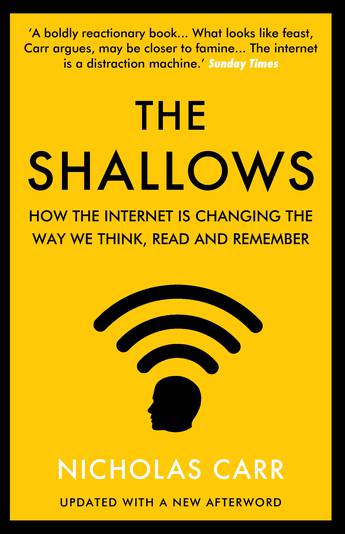
  • My thoughts on ‘The Shallows’ – Nicholas Carr

    My thoughts on ‘The Shallows’ – Nicholas Carr

    I recently finished The Shallows – Nicholas Carr. It was a really interesting exploration about how the internet is changing how we think. It was also super interesting as it was written around 2009-2010, so everything Carr was saying was based on just working on laptops, browsing the net. As I was reading, I just thought about what happened over the next 15 years; what he was observing absolutely blew up in proportion.

    He starts with McLuhan’s phrase, “the medium is the message”, and begins with a history about how “intellectual technologies” such as clocks, maps, documents and books, changed how we humans thought about things like time, geography and space, and knowledgeHe then takes a surprising route through the discovery of neuroplasticity, and sort of points to this as how the media we consume shapes our thinking. From here, he dives into how internet media, which is fragmented, and filled with hyperlinks to encourage rabbitholing, has led to more distracted and fragmented thinking. He points to this as the reason why he and so many others have found it more difficult to finish books or even long articles. By using the media on the internet, he wasn’t exercising the abilities to sit with a long, cohesive text for a long time, developing sustained focus.

    I loved the book, and found it both informative and reassuring. I’ve been interesting in the ideas about how technology shapes us (rather than the other way around), and this provided a nice historical overview of this concept. And, I simply liked the message that developing the skill of sitting with a text for a long time, focusing on its ideas, avoiding distractions and competing texts, was a very valuable and productive way to spend one’s time.

    The book definitely made me feel like reading long texts is essential for deep thinking, and sadly is also a skill that is under attack through the flood of addictive short-form content. It makes me worry quite a lot for students and their abilities to learn, if they’re spending large amounts of time scrolling socials or skimming webpages. I don’t know if I’m catastrophising, but I genuinely feel that this is a very serious issue — where young people are being brought up using social media, which obliterates their abilities to sit with a text, have cohesive thoughts and learn/think deeply. I feel like this could lead to a feeling of disconnection with the world and the self. But, I’m also seeing quite a bit of backlash at the moment against short-form garbage – young people valuing critical thinking, rejecting algorithmic recommendations, and taking control of their attention. So there’s hope!!

  • Fitness Trackers Separate Us From Our Bodies

    My Time and Issues With Fitness Trackers

    I recently ditched my fitness trackers – my Garmin watch and an Oura ring. They started to feel a little toxic, and were bringing me down quite a bit. Towards the end of their use, I began to think about whether the devices were acting as the carrot or the stick. Most of the platforms are set up to be carrots – “motivating” the user to complete challenges, compete with friends, and meet goals for step counts, sleep scores, and stress levels. For some, these might be great incentives to achieve these things, and any failures of them aren’t really dwelt upon. For others, and I am putting myself in this group, they can act as standards that must be met each day. If I fail to meet them, I can feel like I’ve somehow let someone down (I’m not sure if it’s myself or the fitness tracker platform). This constant striving to meet these goals can feel exhausting. Chasing the carrot begins to feel like being hit with the stick; a desperate shuffling along to tick off all the requirements in order to say I’ve had a ‘successful’ or ‘healthy’ day.

    I think the strangest and most ironic outcome of fitness trackers is the stress they cause around sleeping. The devices measure your sleep and often give you a score out of 100. I was usually hitting around 80+ most nights – often in the 90s. But any time I didn’t land in that ballpark, I felt like I’d somehow done something bad – like I’d really screwed up. The outcome of this would simply be moved to the following night, where I would need to make up for the terrible sleep score. On these nights, I would really aim for 90+. But how do you actually make yourself have a good sleep? Consecutive sub-80 scores would compound a feeling of dread, as I thought about the severe damage I must be doing, or the way that I won’t be ‘functioning at my peak level’. What this would accumulate to is the ridiculous situation of lying awake in bed, feeling stressed about not being able to fall asleep, fearing that I would wake up with a low sleep score. I can’t fall asleep because of the stress of not being able to fall asleep. My low sleep score is caused by my fear of getting a low sleep score.

    So, I thought about ways to ‘healthily’ work with these fitness trackers. I tried committing to only checking it once a day. I tried committing to not checking it when I woke up. I thought about only checking it every 3 months to see longer trends rather than a day-by-day increase or decrease of my fitness levels and various scores. I then finally resorted to deleting the apps altogether, and to just have the data uploaded to the platforms through Wi-Fi. But then I thought, why on Earth am I even wearing the device if I’m not actually going to look at the data? So I’ve resorted to taking off the devices altogether and instead wear a normal dumbwatch.

    Fitness Trackers and Our Bodies

    Fitness trackers have a way of separating us from our own bodies. They tell us narratives about our bodies and our health that can contradict our own feelings we have from within them. There have been times when I wake up feeling refreshed, but check the sleep score and see, say, 70/100. I then start to think “you know what, I do actually feel pretty drowsy and unrefreshed”. The opposite is also true; I wake up feeling drowsy and unrefreshed, only to see a sleep score of 90, making me consider whether in fact I do feel refreshed and well slept. These technologies make us second guess our own sense of our bodies. They make our bodies something to be read and analysed, rather than felt from within. They cause a strange sensory dissonance, separating us from how we feel, and what a device tells us about ourselves. I’m not necessarily saying that the fitness trackers are inaccurate in their readings – in fact, I believe their accuracy is beside the point. In other words, I’m not saying there is a discrepancy between what is actually the case, and what is represented in the data. Instead, I’m drawing attention to the separation between what is felt from within the body and what is read from the analysis of the body. And, importantly, I feel that often, what is read and analysed is seen as more accurate, or a more authoritative source of information about our own bodies.

    TV Buddha, 1976 – Nam June Paik

    These sorts of strange, redundant cycles, catastrophes and feedback loops are a common feature of modern existence. These technologies are sold to us as ‘essential’; in order to reach ‘maximum potential’, or to enrich existence in some way, we must adopt them. But after sustained use, we find that in fact, they are part of, or the very cause of, the problem. This is the case for social media, being framed as the great connector while actually driving us apart. It’s the case for fitness trackers promising good health but instead causing obsession and higher stress. These are two examples of technologies of alienation – alienation from others, and alienation from ourselves.

    Technology companies often present their products as a form of ‘help’ – whether by promising to keep us social, improve our health, or, in the case of financial services, make purchases more convenient. However, can these outcomes truly be considered ‘help’? Making it easier for someone to spend their money isn’t really helping them; it’s helping companies get into the pockets of their customers. I think it’s important to remain critical of the technologies we use, questioning their promises and the real consequences of their adoption.

    Leaving the fitness trackers behind led me to rely on my own sense of my body to get an idea of how I was feeling, how I slept, how stressed I was, how active I’ve been. It turns out I don’t need a device to tell me how ready I am for the day; I can feel that pretty well by myself. Who would have thought!? (My partner, who has been saying this for over a year now while I’ve been complaining about the trackers, rolls her eyes.)

  • Turning Reality into Fiction

    One of the most terrifying scenes in a film I watched as a child was in Gore Verbinski’s The Ring. In it, a girl in rags with black hair over her face is being watched on the TV after a character finds a collection of suspicious homemade videos. The girl, Samara, walks right up to the camera before water starts leaking from the TV, and she begins to crawl out of it, into the room with the characters.

    Making a grand entrance in The Ring
    Samara creeping out of the TV in Verbinski’s The Ring

    I was always horrified by this as, to me, it represented a break in the promise that what I see on the screen is separated—disconnected—from the world in which I live. The worlds of reality and fiction can never meet, right? I was more suspicious of my family’s TV after watching that scene, wondering if creatures of fiction were actually able to crawl out and join me in reality. I wondered if they ever would.

    But I’ve realised recently that, very often, we actively try to make our reality into fiction. We seek to ‘elevate’ reality and our view of the world to the realm of stylised, ‘cinematic’, fiction.

    Screens, Social Media & Depersonalisation

    In particular, content we see on screens makes elements of reality seem fictionalised. When we see real-world events on a screen, it often doesn’t feel entirely real; there is a gap between us (the viewers) and what we’re seeing. The screen is a form of mediator. Similarly, a common symptom of anxiety disorders is depersonalisation, or derealisation, which feels like one is viewing themselves from a distance or through a screen. There is a detachment from reality that is felt during depersonalisation, even though viewing it through one’s own eyes. An image used to represent this feeling depicts a person viewing reality through the screen of their own eyes. With screens now so pervasive in our existence, we see so much of what we deem as reality from this removed, mediated position.

    Depersonalisation

    Social media has played a role in drastically ‘fictionalising’ reality, furthering this detachment. The situation is greatly amplified in the current times with content creation techniques such as the ability to lay music over real-life footage. War footage shot on smartphones is overlaid with dramatic music from or inspired by film scores, reminiscent of dramatic scenes from cinema. Footage from the Russia-Ukraine war and the conflict in the Middle East, shared on social media, have demonstrated this, as have videos of flattened villages from landslides and other natural disasters. Footage of atrocities is fictionalised by overlaying it with dramatic or sad music before uploaded to social media, stripping it of its realism. People’s own important personal moments—graduations, completing races and challenges, reuniting with family after years apart, nights out with friends—are posted online, overlaid with music to give it the cinematic gloss we see in films.

    The fundamental role of music in films is to lift a scene from the territory of the mundane real into a transcended territory of stylised fiction. Placing music over footage of ourselves attempts to do the exact same.

    What does this do to reality?

    Since the early days of Instagram, we’ve been creating high standards that actual reality struggles to live up to. Placing filters on images of ourselves and our lives’ curated showreels, we’ve been creating online Doppelgängers1 of ourselves for years now that we’ve constantly felt we’re failing to live up to. We see the fictions of other people’s lives and wonder why ours don’t feel so exciting.

    The mundane everyday often simply isn’t ‘good enough’. Instead, it only meets our expectations when it is captured, stylised, fictionalised, and if it is approved by (mostly anonymous) ‘followers’ through their likes.

    Make it “Cinematic”

    The news is an industry that thrives on this fictionalising of reality. We see this especially in commercials for news programs. In these, we see ‘exciting’ scenes from past news reports used in the same way that exciting scenes for an upcoming film or TV show are used in trailers. Shots of a reporter at a real (often tragic) scene, saying things like “authorities are still searching for survivors,” are used to advertise and market the news—it operates by turning reality into a form of entertainment. News organisations use sound and music that is intentionally ‘serious’, ‘cinematic’, because, just like social media platforms, most rely on advertisement revenue, incentivising them to “add a sense of drama to hook in viewers and keep them watching”.2 Reality (footage) is paired with aspects of entertainment to decouple it from the mundane—or, perhaps more accurately, to place it within the dramatised territory of entertainment. 

    This fictionalising more shamelessly plays out in reality TV shows, an act that is exaggerated and critiqued in stories such as The Hunger Games and Squid Game. Susan Collins conceived of the idea for The Hunger Games as she flicked between war coverage on the news and a reality TV show, linking these two forms of ‘entertainment’.3 In the not too distant future, perhaps she wouldn’t have had to see the reality TV show: more and more the news alone makes reality into a thriller.

    (I point out that I am not referring here to the “fake news” ideas of Trump and the more conspiratorial ends of the political spectrum.)

    This is not only done by entertainment corporations—anyone with a smartphone can take part in it. News organisations for decades have picked which events and places in the world to build narratives around. Now, however, it is the individual lives of the public that can be fictionalised—and we do it to ourselves. The fictions are bespoke to us, and we are the ones writing, producing, and directing them.

    We harvest everyday reality using cameras and microphones, manipulate it, and reconstruct it into a fictional showreel. Experiencing a beautiful landscape is one thing, but filming it, maybe stylising it with a filter, and overlaying it with some ‘cinematic’ music is what really gets us going. It’s no wonder there is a wash of YouTube tutorials describing how to make footage more ‘cinematic’ and an entire market of ‘cinematic’ LUTs and music to go along with it all. In this way, the reality in which we live is a sort of mediated territory that only acts as a means to get somewhere else. Everyday life holds the raw materials that we capture, enhance, and share to build our fictions. It is merely instrumental.

    Link
    Link
    Link

    Life in the mundanity of the everyday is not glossy enough to satisfy our expectations. This is the main concept of various speculative fiction stories that involve virtual reality technologies—Neal Stephenson’s ‘Snow Crash’ and Ernest Cline’s ‘Ready Player One’, for example. The temptation to immerse oneself in a stylised, exciting virtual reality trumps the desire to remain unplugged in the real world.


    AirPods and Isolation

    For myself, the feeling of fictionalised reality also often comes from listening to music while on public transport. 

    woman sitting on chair near window

    I listen to a lovely ambient piece of music through noise-cancelling headphones while the golden sun sifts through the train windows, across people’s faces, the train walls, and the advertisements. With the sound of those around me blocked out, I feel like I’m in a movie scene—that I’ve reached some higher level of existence. My reality has been altered in this moment—coloured in some way. Reality seems to glow.

    I feel like I’m a (main) character in a film. I feel like I’m the only one experiencing it. I recognise the narcissism, but it’s often difficult to think that anyone else on that train could possibly be having the same type of profound experience.

    This is exactly how these technologies are marketed. An advertisement for Apple’s AirPods Pros shows a woman experiencing this form of ‘enhanced’, self-focused, individualised reality before switching on ‘transparency mode’ to let the world in—to rejoin reality.4

    https://www.youtube-nocookie.com/embed/QjgXrMdx9R8?rel=0&autoplay=0&showinfo=0&enablejsapi=0

    Technologies like these are sold to us in ways that acknowledge their ability to fictionalise reality and to centre the world around us. 

    Though, just as they separate us from the real, our technologies also play a role in isolating ourselves from the presence of others. We would prefer to stay in our own little bubbles than immerse ourselves in the presence of others. We feel like wearing noise-cancelling headphones is a necessity in any situation where we are surrounded by strangers. Noise-cancelling literally “blocks out” the sounds of others, which is so much a part of their presence. We actively pursue ridding ourselves of it, avoiding it as much as possible. This ultimately atomises society. Just as echo chambers on social media create ideological separations between us and make us struggle to fully understand and relate to those with views contrary to our own, noise-cancelling headphones do a similar role in separating us from each other through stripping away elements of their physical presence.

    Do We Demand to be Separated?

    Is this a result of higher-density living? In The Age of Surveillance Capitalism, Shoshana Zuboff draws on the work of pioneering sociologist Emile Durkheim, who pointed out at the dawn of the twentieth century that technologies are summoned into reality by the “causal power” of the “perennial human quest to live effectively in our ‘conditions of existence’”.5 Technologies, being summoned by the demands of the public, tell us something about the culture into which the technology is delivered.

    man and woman sitting chair inside the train
    Photo by Victoriano Izquierdo on Unsplash

    Then, do we demand to be separated? In his 1845 novel, Sybil, or The Two Nations, Benjamin Disraeli wrote of the loneliness of urban London life during this period. People were “not in a state of cooperation, but of isolation”.66 For many, urban life introduces the often unwanted mingling of strangers, creating a demand to separate from them when possible, summoning technologies such as noise-cancelling headphones into existence, which may cause further isolation.

    Is it an issue that we experience this discomfort? Will repeatedly ‘treating’ these symptoms broaden the gaps between us? 

    Are we lonely because we have been sold the idea that it is desirable to separate ourselves from one another?

    Who Benefits?

    There are, of course, people who benefit from this industry of fictionalising reality through the entertainment enhancements of filters, edits, and music. Social media platforms certainly do, through their users creating, sharing, and engaging with this content, all while soaking up advertisements. News corporations also. Musicians in some way, but only through growing ‘popularity’ if their music is used—very rarely in direct monetary compensation. 

    We recognised very early on that social media paints unrealistic representations of people’s lives and that this causes mental health issues for users.7 But we haven’t made any real efforts in fixing this problem. In fact, it has grown with new platforms and is carried out in even more sophisticated ways, making for even more unrealistic reflections of reality. The owners of the platforms don’t care about this deconstruction of reality and what it does to both the social fabric and the minds of individuals. As long as it is addictive and can facilitate flooding users with advertisements, they seem fine with it.

    I tend to think about that often. Social media use—this experience of being washed in content and advertisements, in messages and coercions for the sake of generating revenue for the advertisers and platform’s owners, and the obliteration of any clear sense of a true, unmanipulated self—is what reality is for a very large portion of the lives of much of the world’s population. How can that be? How could the nature of twenty-first century existence have gotten this manipulative and unkind? How have we consented to it?


    Technology and Divisions

    In these two instances—noise-cancelling headphones and overlaying music with real-world footage—technology is creating divisions: divisions between us and those around us and between us and our reality. Do technologies inevitably have this effect? Technological innovation has played a role in world history in advancing certain civilisations to be able to dominate and maintain dominance over others. This continues today, as this position is what is strived for in technological arms races. But the technologies owned not by states for warfare but by ourselves for ‘convenience’, ‘entertainment’, or ‘comfort’, assert a power over us in complex ways, changing our understandings of and relationships to ourselves, others, and reality. This ought to be recognised and challenged.

    Though it seems trivial, I find myself thinking about the concept of wearing noise-cancelling headphones on public transport fairly frequently. I’ll admit—I take part in it very regularly. But I often ask myself if I should be doing it. Sure, it is comforting in the moment, and I have had those transcendent experiences with the sunlight and the ambient music, etc. But there is a tension I feel: Is this what we should be doing? Should we so actively be separating ourselves from one another? Should we be actively engaging with each other more?

    Are we feeling the pains of becoming the archetype of neoliberal individualism—what Zuboff describes as the “mythical, atomised, isolated individual”?8

    I think it’s important to recognise reality and the mundane as simply themselves—not as fodder for content or the waiting room for the next exciting thing. Yet, I don’t think it’s possible to entirely avoid this construction of narratives in and about our lives. Perhaps it’s the level of stylising involved. 

    What’s clear to me is that reality is not entertainment. It’s one thing for entertainment to reflect and stylise reality and the stories within it, but that doesn’t mean we need to completely collapse reality and entertainment onto the same plane.

    Personally, I would like to keep Samara behind the screen.

    References:

    1. Klein, N. (2023). Doppelganger. Knopf Canada. ↩︎
    2. Gorvett, Z. (2020, May 12). How the News Changes the Way We Think and Behave. BBC; BBC. https://www.bbc.com/future/article/20200512-how-the-news-changes-the-way-we-think-and-behave ↩︎
    3. Sellers, J. A. (2008, June 8). “The Hunger Games”: A Dark Horse Breaks Out. PublishersWeekly.com. https://www.publishersweekly.com/pw/print/20080609/9915-a-dark-horse-breaks-out.html ↩︎
    4. Apple. (2020, April). Flume feat. Toro y Moi – The Difference (Apple x Matilda Sakamoto Dance Video). YouTube. ↩︎
    5. Zuboff, S. (2019). The Age of Surveillance Capitalism: The Fight for a Human Future at the New Frontier of Power. Profile Books, 32. ↩︎
    6. Sacks, J. (2021). Morality: Restoring the Common Good in Divided Times. Hodder & Stoughton, 322. ↩︎
    7. Haidt, J. (2024). The Anxious Generation. Penguin. ↩︎
    8. Zuboff, S. (2019). The Age of Surveillance Capitalism: The Fight for a Human Future at the New Frontier of Power. Profile Books, 33. ↩︎