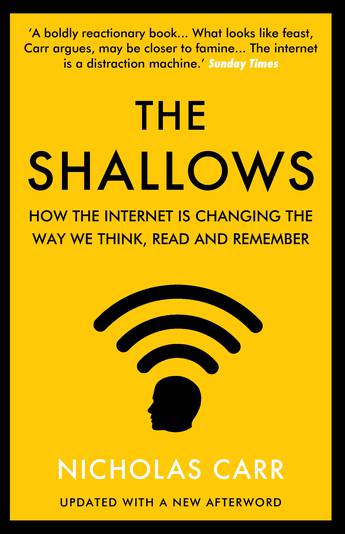
I recently finished The Shallows – Nicholas Carr. It was a really interesting exploration about how the internet is changing how we think. It was also super interesting as it was written around 2009-2010, so everything Carr was saying was based on just working on laptops, browsing the net. As I was reading, I just thought about what happened over the next 15 years; what he was observing absolutely blew up in proportion.
He starts with McLuhan’s phrase, “the medium is the message”, and begins with a history about how “intellectual technologies” such as clocks, maps, documents and books, changed how we humans thought about things like time, geography and space, and knowledge. He then takes a surprising route through the discovery of neuroplasticity, and sort of points to this as how the media we consume shapes our thinking. From here, he dives into how internet media, which is fragmented, and filled with hyperlinks to encourage rabbitholing, has led to more distracted and fragmented thinking. He points to this as the reason why he and so many others have found it more difficult to finish books or even long articles. By using the media on the internet, he wasn’t exercising the abilities to sit with a long, cohesive text for a long time, developing sustained focus.
I loved the book, and found it both informative and reassuring. I’ve been interesting in the ideas about how technology shapes us (rather than the other way around), and this provided a nice historical overview of this concept. And, I simply liked the message that developing the skill of sitting with a text for a long time, focusing on its ideas, avoiding distractions and competing texts, was a very valuable and productive way to spend one’s time.
The book definitely made me feel like reading long texts is essential for deep thinking, and sadly is also a skill that is under attack through the flood of addictive short-form content. It makes me worry quite a lot for students and their abilities to learn, if they’re spending large amounts of time scrolling socials or skimming webpages. I don’t know if I’m catastrophising, but I genuinely feel that this is a very serious issue — where young people are being brought up using social media, which obliterates their abilities to sit with a text, have cohesive thoughts and learn/think deeply. I feel like this could lead to a feeling of disconnection with the world and the self. But, I’m also seeing quite a bit of backlash at the moment against short-form garbage – young people valuing critical thinking, rejecting algorithmic recommendations, and taking control of their attention. So there’s hope!!
Social media use is unhealthy. There’s no denying that it can lead to all sorts of negative impacts on mental health. There’s a seemingly endless debate I go through, about whether to use it or not. I’ve also been feeling this about the use of streaming platforms which severely underpay artists, and also encourage passive consumption of culture. It’s a shame that musicians are forced to use these platforms that cause so much damage – particularly artists starting out in their careers, trying to build an initial audience.
I recently decided to come up with a process to approach making social media content in a way that feels sustainable for me, while avoiding the traps it sets up every time I open the app. I wanted to approach it as a true creative process, adhering to experimentation and genuine creativity.
Here’s what I do:
Every month or so, I head out with my camera and film short clips — around 20 seconds each. These clips are anything from hazy, blurry subjects, to clearer videos of birds and nature. They’re really just of what I find interesting and pleasing at the time.
Then I come home and open up Da Vinci Resolve, and create about 10 timelines. I then go through the process of loading in a video and pairing it with some music. The music is typically a demo of something I’ve been working on over the past months — I keep a “demos” folder full of .mp3s of tracks I’m currently working on handy in my Finder. Sometimes I load these .mp3s into Ableton Live and further process them through transposition and reversing, or sometimes other more drastic methods. I use .mp3s because I’m not really going for the highest spec content – ultimately, these are mostly going to be played out of a phone speaker, and are already heavily compressed during the upload process.
I then render out these 10 clips and load them into a scheduler app called Buffer (not sponsored by them or anything). This allows me to schedule these 10 posts as a batch: 2x posts a week (Mondays and Thursdays) gets me just over a month, ready for the next round.
For the captions, I come up with a theme for the month and just blurt out short phrases of 1 – 4 words: anything that comes to mind based on the theme. Past themes, for example, have been time, distance, and holding/grasping something. I then do a little caption about the music itself, and sometimes a sentence about the visual.
Once scheduled, if I don’t want to, I don’t have to worry about content for another month.
From start to finish, I think the process takes me about 2.5 hours, from leaving the house to film the videos to clicking the final ‘Schedule’ button.
But this process allows me to output a flow of content that I actually enjoy making, and avoid scrolling on the platforms themselves. It’s been working well for about 2.5 months now.
I know people would say I should be on the platforms engaging with other users, commenting on their posts. But I just don’t enjoy being on the platforms, and to be honest I think it would be great if we moved away from these types of platforms altogether. It’s crazy that we continue to use these platforms when we know how unhealthy they are.
Hopefully a more sustainable platform for sharing that treats its users with respect, and is centred around better values is around the corner.
An issue I’ve had recently with online platforms is that users are often existing within the boundaries of the larger corporations that own the platforms. Instagram, for example, is a place where it feels like it could be a good space to build and showcase a portfolio of work, and build a community around it. However, the content that is uploaded to these platforms are then governed by the rules set by the owners — the algorithmic recommendations, the incentives to stay on the platform, the pairing of the content alongside ads. These platforms don’t feel like a space that can be personalised and controlled by the users whose content fill them.
So I want this website to first and foremost be a hub for all of my creative and academic work. Housed within it will be links to all of my musical and written academic work, contact information, and a casual blog of updates and ideas. These sorts of spaces do not manipulate readers in any way by the owners of the platform.
Browse freely, read, listen, reach out — do as you please. I’m just here to share what I’m doing, and you’re just here to hear about it (I presume!)
The internet had — and still has — the potential to be an excellent space for virtual community building and sharing of work. Of course, nothing beats face-to-face contexts for this, but there are undeniably things that the net can offer that were not possible before it — primarily, the sharing of work to reach an audience globally. It’s just that currently the social media platforms that claim to be the beacons of these activities are based on goals that aren’t aligned with the values of community, artistic endeavor, and shared experience.
So that is what I’m aiming to do here: host and share my work, and attempt to embrace some of the ‘healthy’ values and goals that the internet can be used to pursue.
One of the most terrifying scenes in a film I watched as a child was in Gore Verbinski’s The Ring. In it, a girl in rags with black hair over her face is being watched on the TV after a character finds a collection of suspicious homemade videos. The girl, Samara, walks right up to the camera before water starts leaking from the TV, and she begins to crawl out of it, into the room with the characters.
Samara creeping out of the TV in Verbinski’s The Ring
I was always horrified by this as, to me, it represented a break in the promise that what I see on the screen is separated—disconnected—from the world in which I live. The worlds of reality and fiction can never meet, right? I was more suspicious of my family’s TV after watching that scene, wondering if creatures of fiction were actually able to crawl out and join me in reality. I wondered if they ever would.
But I’ve realised recently that, very often, we actively try to make our reality into fiction. We seek to ‘elevate’ reality and our view of the world to the realm of stylised, ‘cinematic’, fiction.
Screens, Social Media & Depersonalisation
In particular, content we see on screens makes elements of reality seem fictionalised. When we see real-world events on a screen, it often doesn’t feel entirely real; there is a gap between us (the viewers) and what we’re seeing. The screen is a form of mediator. Similarly, a common symptom of anxiety disorders is depersonalisation, or derealisation, which feels like one is viewing themselves from a distance or through a screen. There is a detachment from reality that is felt during depersonalisation, even though viewing it through one’s own eyes. An image used to represent this feeling depicts a person viewing reality through the screen of their own eyes. With screens now so pervasive in our existence, we see so much of what we deem as reality from this removed, mediated position.
Social media has played a role in drastically ‘fictionalising’ reality, furthering this detachment. The situation is greatly amplified in the current times with content creation techniques such as the ability to lay music over real-life footage. War footage shot on smartphones is overlaid with dramatic music from or inspired by film scores, reminiscent of dramatic scenes from cinema. Footage from the Russia-Ukraine war and the conflict in the Middle East, shared on social media, have demonstrated this, as have videos of flattened villages from landslides and other natural disasters. Footage of atrocities is fictionalised by overlaying it with dramatic or sad music before uploaded to social media, stripping it of its realism. People’s own important personal moments—graduations, completing races and challenges, reuniting with family after years apart, nights out with friends—are posted online, overlaid with music to give it the cinematic gloss we see in films.
The fundamental role of music in films is to lift a scene from the territory of the mundane real into a transcended territory of stylised fiction. Placing music over footage of ourselves attempts to do the exact same.
What does this do to reality?
Since the early days of Instagram, we’ve been creating high standards that actual reality struggles to live up to. Placing filters on images of ourselves and our lives’ curated showreels, we’ve been creating online Doppelgängers1 of ourselves for years now that we’ve constantly felt we’re failing to live up to. We see the fictions of other people’s lives and wonder why ours don’t feel so exciting.
The mundane everyday often simply isn’t ‘good enough’. Instead, it only meets our expectations when it is captured, stylised, fictionalised, and if it is approved by (mostly anonymous) ‘followers’ through their likes.
Make it “Cinematic”
The news is an industry that thrives on this fictionalising of reality. We see this especially in commercials for news programs. In these, we see ‘exciting’ scenes from past news reports used in the same way that exciting scenes for an upcoming film or TV show are used in trailers. Shots of a reporter at a real (often tragic) scene, saying things like “authorities are still searching for survivors,” are used to advertise and market the news—it operates by turning reality into a form of entertainment. News organisations use sound and music that is intentionally ‘serious’, ‘cinematic’, because, just like social media platforms, most rely on advertisement revenue, incentivising them to “add a sense of drama to hook in viewers and keep them watching”.2 Reality (footage) is paired with aspects of entertainment to decouple it from the mundane—or, perhaps more accurately, to place it within the dramatised territory of entertainment.
This fictionalising more shamelessly plays out in reality TV shows, an act that is exaggerated and critiqued in stories such as The Hunger Games and Squid Game. Susan Collins conceived of the idea for The Hunger Games as she flicked between war coverage on the news and a reality TV show, linking these two forms of ‘entertainment’.3 In the not too distant future, perhaps she wouldn’t have had to see the reality TV show: more and more the news alone makes reality into a thriller.
(I point out that I am not referring here to the “fake news” ideas of Trump and the more conspiratorial ends of the political spectrum.)
This is not only done by entertainment corporations—anyone with a smartphone can take part in it. News organisations for decades have picked which events and places in the world to build narratives around. Now, however, it is the individual lives of the public that can be fictionalised—and we do it to ourselves. The fictions are bespoke to us, and we are the ones writing, producing, and directing them.
We harvest everyday reality using cameras and microphones, manipulate it, and reconstruct it into a fictional showreel. Experiencing a beautiful landscape is one thing, but filming it, maybe stylising it with a filter, and overlaying it with some ‘cinematic’ music is what really gets us going. It’s no wonder there is a wash of YouTube tutorials describing how to make footage more ‘cinematic’ and an entire market of ‘cinematic’ LUTs and music to go along with it all. In this way, the reality in which we live is a sort of mediated territory that only acts as a means to get somewhere else. Everyday life holds the raw materials that we capture, enhance, and share to build our fictions. It is merely instrumental.
Life in the mundanity of the everyday is not glossy enough to satisfy our expectations. This is the main concept of various speculative fiction stories that involve virtual reality technologies—Neal Stephenson’s ‘Snow Crash’ and Ernest Cline’s ‘Ready Player One’, for example. The temptation to immerse oneself in a stylised, exciting virtual reality trumps the desire to remain unplugged in the real world.
AirPods and Isolation
For myself, the feeling of fictionalised reality also often comes from listening to music while on public transport.
I listen to a lovely ambient piece of music through noise-cancelling headphones while the golden sun sifts through the train windows, across people’s faces, the train walls, and the advertisements. With the sound of those around me blocked out, I feel like I’m in a movie scene—that I’ve reached some higher level of existence. My reality has been altered in this moment—coloured in some way. Reality seems to glow.
I feel like I’m a (main) character in a film. I feel like I’m the only one experiencing it. I recognise the narcissism, but it’s often difficult to think that anyone else on that train could possibly be having the same type of profound experience.
This is exactly how these technologies are marketed. An advertisement for Apple’s AirPods Pros shows a woman experiencing this form of ‘enhanced’, self-focused, individualised reality before switching on ‘transparency mode’ to let the world in—to rejoin reality.4
Technologies like these are sold to us in ways that acknowledge their ability to fictionalise reality and to centre the world around us.
Though, just as they separate us from the real, our technologies also play a role in isolating ourselves from the presence of others. We would prefer to stay in our own little bubbles than immerse ourselves in the presence of others. We feel like wearing noise-cancelling headphones is a necessity in any situation where we are surrounded by strangers. Noise-cancelling literally “blocks out” the sounds of others, which is so much a part of their presence. We actively pursue ridding ourselves of it, avoiding it as much as possible. This ultimately atomises society. Just as echo chambers on social media create ideological separations between us and make us struggle to fully understand and relate to those with views contrary to our own, noise-cancelling headphones do a similar role in separating us from each other through stripping away elements of their physical presence.
Do We Demand to be Separated?
Is this a result of higher-density living? In The Age of Surveillance Capitalism, Shoshana Zuboff draws on the work of pioneering sociologist Emile Durkheim, who pointed out at the dawn of the twentieth century that technologies are summoned into reality by the “causal power” of the “perennial human quest to live effectively in our ‘conditions of existence’”.5 Technologies, being summoned by the demands of the public, tell us something about the culture into which the technology is delivered.
Then, do we demand to be separated? In his 1845 novel, Sybil, or The Two Nations, Benjamin Disraeli wrote of the loneliness of urban London life during this period. People were “not in a state of cooperation, but of isolation”.66 For many, urban life introduces the often unwanted mingling of strangers, creating a demand to separate from them when possible, summoning technologies such as noise-cancelling headphones into existence, which may cause further isolation.
Is it an issue that we experience this discomfort? Will repeatedly ‘treating’ these symptoms broaden the gaps between us?
Are we lonely because we have been sold the idea that it is desirable to separate ourselves from one another?
Who Benefits?
There are, of course, people who benefit from this industry of fictionalising reality through the entertainment enhancements of filters, edits, and music. Social media platforms certainly do, through their users creating, sharing, and engaging with this content, all while soaking up advertisements. News corporations also. Musicians in some way, but only through growing ‘popularity’ if their music is used—very rarely in direct monetary compensation.
We recognised very early on that social media paints unrealistic representations of people’s lives and that this causes mental health issues for users.7 But we haven’t made any real efforts in fixing this problem. In fact, it has grown with new platforms and is carried out in even more sophisticated ways, making for even more unrealistic reflections of reality. The owners of the platforms don’t care about this deconstruction of reality and what it does to both the social fabric and the minds of individuals. As long as it is addictive and can facilitate flooding users with advertisements, they seem fine with it.
I tend to think about that often. Social media use—this experience of being washed in content and advertisements, in messages and coercions for the sake of generating revenue for the advertisers and platform’s owners, and the obliteration of any clear sense of a true, unmanipulated self—is what reality is for a very large portion of the lives of much of the world’s population. How can that be? How could the nature of twenty-first century existence have gotten this manipulative and unkind? How have we consented to it?
Technology and Divisions
In these two instances—noise-cancelling headphones and overlaying music with real-world footage—technology is creating divisions: divisions between us and those around us and between us and our reality. Do technologies inevitably have this effect? Technological innovation has played a role in world history in advancing certain civilisations to be able to dominate and maintain dominance over others. This continues today, as this position is what is strived for in technological arms races. But the technologies owned not by states for warfare but by ourselves for ‘convenience’, ‘entertainment’, or ‘comfort’, assert a power over us in complex ways, changing our understandings of and relationships to ourselves, others, and reality. This ought to be recognised and challenged.
Though it seems trivial, I find myself thinking about the concept of wearing noise-cancelling headphones on public transport fairly frequently. I’ll admit—I take part in it very regularly. But I often ask myself if I should be doing it. Sure, it is comforting in the moment, and I have had those transcendent experiences with the sunlight and the ambient music, etc. But there is a tension I feel: Is this what we should be doing? Should we so actively be separating ourselves from one another? Should we be actively engaging with each other more?
Are we feeling the pains of becoming the archetype of neoliberal individualism—what Zuboff describes as the “mythical, atomised, isolated individual”?8
I think it’s important to recognise reality and the mundane as simply themselves—not as fodder for content or the waiting room for the next exciting thing. Yet, I don’t think it’s possible to entirely avoid this construction of narratives in and about our lives. Perhaps it’s the level of stylising involved.
What’s clear to me is that reality is not entertainment. It’s one thing for entertainment to reflect and stylise reality and the stories within it, but that doesn’t mean we need to completely collapse reality and entertainment onto the same plane.
Personally, I would like to keep Samara behind the screen.
Gorvett, Z. (2020, May 12). How the News Changes the Way We Think and Behave. BBC; BBC. https://www.bbc.com/future/article/20200512-how-the-news-changes-the-way-we-think-and-behave ↩︎
Sellers, J. A. (2008, June 8). “The Hunger Games”: A Dark Horse Breaks Out. PublishersWeekly.com. https://www.publishersweekly.com/pw/print/20080609/9915-a-dark-horse-breaks-out.html ↩︎
Apple. (2020, April). Flume feat. Toro y Moi – The Difference (Apple x Matilda Sakamoto Dance Video). YouTube. ↩︎
Zuboff, S. (2019). The Age of Surveillance Capitalism: The Fight for a Human Future at the New Frontier of Power. Profile Books, 32. ↩︎
Sacks, J. (2021). Morality: Restoring the Common Good in Divided Times. Hodder & Stoughton, 322. ↩︎
Haidt, J. (2024). The Anxious Generation. Penguin. ↩︎
Zuboff, S. (2019). The Age of Surveillance Capitalism: The Fight for a Human Future at the New Frontier of Power. Profile Books, 33. ↩︎